
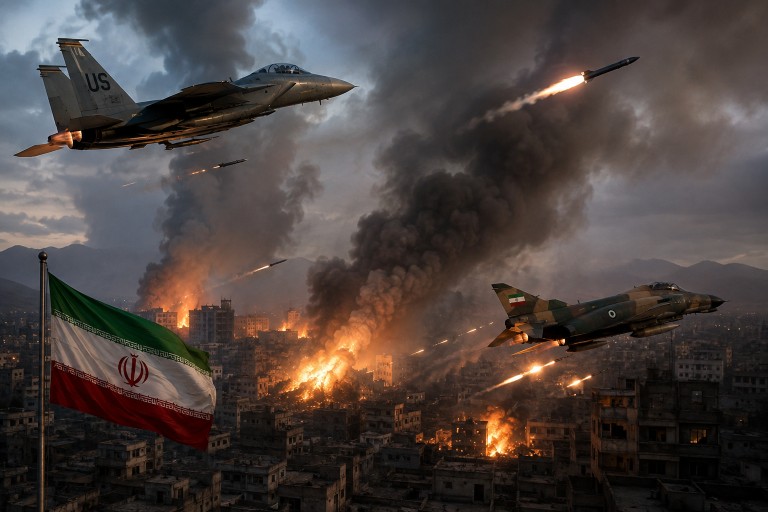
Recent exchanges of airstrikes between the United States and Iran have heightened fears of a potential escalation into wider hostilities in the Middle East. The U.S. military launched new attacks targeting entities associated with Iran’s Islamic Revolutionary Guard Corps (IRGC), citing these actions as a response to Iranian threats against American personnel and attempts to disrupt commercial shipping in the strategic Strait of Hormuz.
In retaliation, Iran launched missile and drone strikes on U.S. interests across several regional countries, including Jordan, Bahrain, Kuwait, and Iraq. Jordanian military forces reported the interception of 10 ballistic missiles fired by Iran, while three additional missiles landed in uninhabited areas. Although no immediate casualties or direct hits were confirmed at the U.S. military training facility in Jordan, tensions remain high.
Iran also claimed responsibility for strikes near a U.S. base in Erbil, Iraq, with further missile and drone activities noted in Kuwait. In Bahrain, air-raid sirens were triggered as part of the regional unrest. The situation has sparked concerns over the security of the Strait of Hormuz, a vital corridor for global oil transportation. Subsequent to these developments, oil prices have surged, and Iran has threatened to halt oil exports from the Gulf if the U.S. escalates its military or economic measures.
Amid the rising tensions, Iranian officials have denounced the U.S. military actions, with President Masoud Pezeshkian indicating Tehran’s readiness to respond if the U.S. does not uphold earlier commitments aimed at de-escalating the situation. The current state of affairs follows a period where the conflict had shifted towards sanctions and economic pressure rather than direct military engagement. However, with the recent hostilities, there is growing anxiety that these efforts could unravel, leading to renewed and sustained military conflict in the region.
Both nations have issued stern warnings, with U.S. President Donald Trump threatening a more forceful response should Iran continue its attacks, while Iranian officials assert their willingness to defend their interests through military and diplomatic channels. The precarious situation underscores the fragility of peace efforts and the potential for further destabilization in the Middle East.