
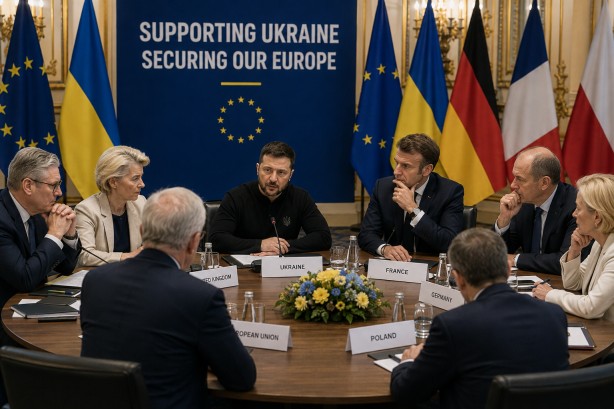
In a significant move to bolster Ukraine’s defenses amidst heightened Russian aggression, European leaders are convening in Kyiv to address the country’s pressing need for air-defense systems. The gathering, dubbed the Coalition of the Willing, is spearheaded by Britain, France, and Germany, with additional participation from other European leaders through remote connections. The discussions also see the presence of EU Council President Antonio Costa, underscoring the importance the EU places on supporting Ukraine during this critical time.
The urgency of the situation stems from an increase in Russian missile strikes targeting Ukrainian cities, including Kyiv, that have resulted in civilian casualties and substantial damage to residential areas. Seeking to counter these threats, Ukraine has made repeated appeals to its allies for more air-defense systems and interceptor missiles. In response, Britain is anticipated to pledge further support, while France is set to initiate local production of the long-range SCALP missile. Additionally, France has promised to deliver more interceptor missiles to enhance Ukraine’s defensive capabilities.
Ukrainian President Volodymyr Zelenskyy has highlighted a concerning decline in the delivery of Patriot interceptor missiles to Ukraine. The country received 675 of these missiles in 2023, a number that fell to 364 in 2025, with forecasts for 2026 showing a further decrease to 264. As winter approaches, Kyiv is urgently seeking at least 300 interceptors to ensure adequate protection for its populace against ongoing missile threats.
Ukraine’s reliance on advanced Western air-defense systems is critical, especially as Russian ballistic missiles pose a challenging interception task. European allies are therefore exploring ways to boost the supply of these vital defense systems while simultaneously seeking strategies to maintain diplomatic and economic pressure on Moscow.
The meeting in Kyiv emphasizes the collective commitment of European nations to support Ukraine in safeguarding its cities and civilians from escalating attacks, thereby reinforcing the broader objective of stabilizing the region and counteracting Russian military aggression.