
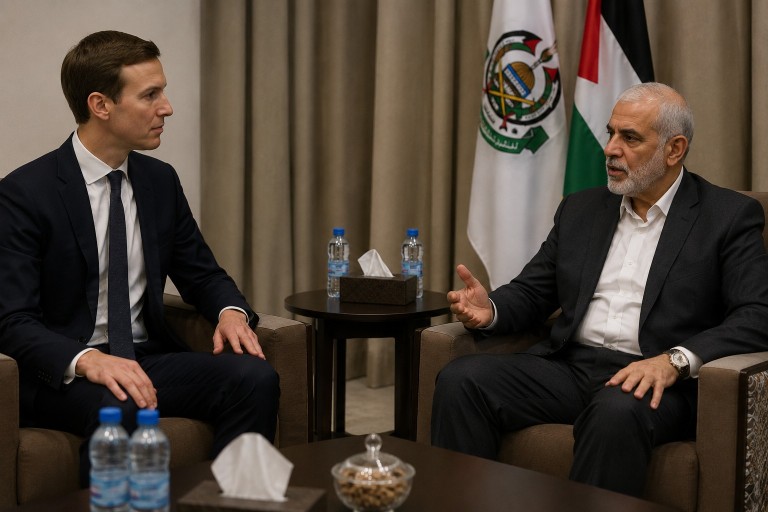
Jared Kushner, son-in-law and envoy of Donald Trump, engaged in a significant diplomatic meeting with Khalil al-Hayya, the political leader of Hamas, in Egypt on Sunday. This meeting marks a renewed effort by the United States to revive a stalled ceasefire plan in Gaza. Kushner’s diplomatic tour is set to continue with a scheduled meeting with Israeli Prime Minister Benjamin Netanyahu, who has recently dismissed a US-backed 15-point proposal for advancing the ceasefire.
The proposed plan outlines a gradual disarmament of Hamas, alongside a cessation of Israeli military activities and a withdrawal from certain areas of Gaza. It also proposes reconstruction efforts and the introduction of international forces to help sustain security. However, while Hamas has expressed its commitment to the road map, it insists that Israel must halt attacks and pull back to the agreed “yellow line” before any implementation occurs. Additionally, Hamas has tied the relinquishment of its heavier armaments to progress towards establishing a Palestinian state, an idea that Netanyahu’s administration opposes.
Netanyahu has maintained that Israeli forces will not completely withdraw from Gaza until Hamas is fully disarmed, posing a significant obstacle to key components of the ceasefire plan, including reconstruction and the deployment of international forces. Kushner’s discussions with Hamas, attended by officials from Egypt, Qatar, and Turkey, focused on gaining Hamas’s agreement to the disarmament aspect of the plan before his subsequent meeting with Netanyahu.
In addition to the meeting with Netanyahu, Kushner is expected to be joined by former British Prime Minister Tony Blair and Nickolay Mladenov, director of the Board of Peace. Several countries in the region, such as Saudi Arabia, the United Arab Emirates, Jordan, Pakistan, and Indonesia, have criticized Israel’s rejection of the US-backed road map and are calling for swift action to prevent further delays.
This intensified diplomatic effort comes at a politically sensitive time for Netanyahu, who faces pressure ahead of Israel’s October election. His coalition government includes ministers advocating for a stricter stance on Gaza, casting uncertainty over the future of the ceasefire plan.